Unbundle Congress
A proposal for reform

I think Congress’s design is stale, and it’s possible to fix this with a constitutional amendment. Constitutional amendments require a lot of people to be on board, but I think this is achievable enough to give a serious try. In this post, I’ll detail the ‘proof of concept’ idea, and in future posts will discuss feasibility, flexibility, and desirability. (This post is a sketch of the idea—in the ‘flexibility’ section it’ll be fleshed out in more detail, but there are multiple ways to go from a skeleton to a finished proposal.)
The Senate
The Senate is perfect the way it is protected in important ways by Article V. This proposal leaves the Senate as is.
The House of Representatives
Current
Currently, states create districts that elect a single representative for two years, who votes on all laws under consideration. They have about a dozen staffers to help them consider and draft legislation; those staffers are typically specialized to have different areas of expertise and responsibility. Representatives can also be members of committees or subcommittees, which are smaller groups that draft nearly all of the legislation that makes it to the floor.
The Congressional system is gradually pushing towards a megabill system, where party leadership will negotiate on a single bill which covers nearly all concerns, rather than negotiating separately on many different bills. The main job of representatives is to learn their district and how to win elections in it, contributing one unit of strength to their party in the national contest.
Local Politics → National Politics
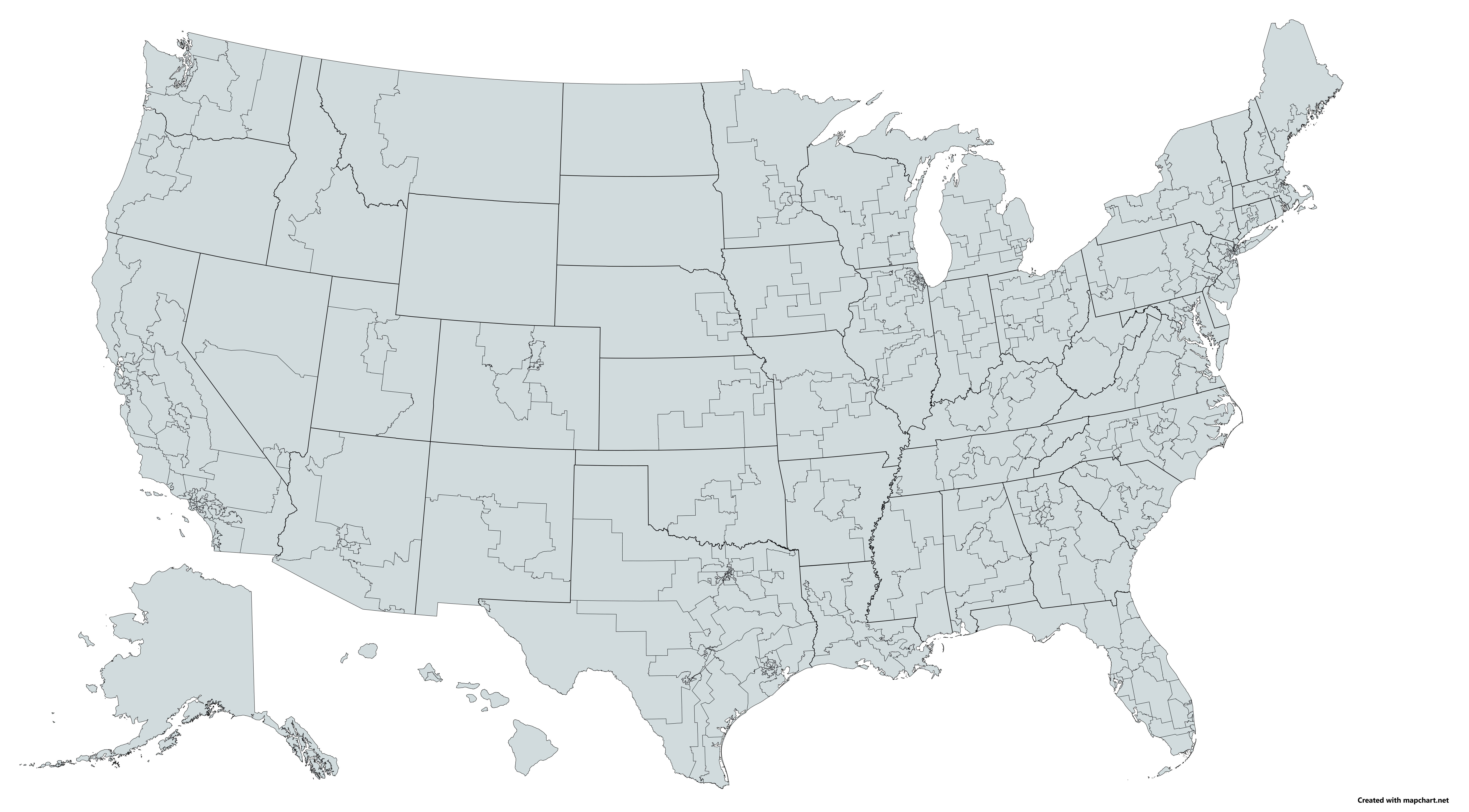
While some people care about issues in their district and local politics, most voters care primarily about national issues, and view the party affiliation of the candidates as more important than their personal qualities. As Congressional districts already have roughly equal numbers of voters in them, switching to national proportional representation (and eliminating Congressional districts) would give voters roughly the same amount of power as before.
Proportional party-list systems are simple; each party puts forward an ordered slate of candidates, voters choose their favorite party, and then the slots are split between the parties based on how many votes they received. (There are slightly variations in how to deal with rounding, but we can keep the system already used in the US to determine how to apportion seats between states after the Census.) Those lists can be generated by any mechanism the parties prefer; party leaders could pick their favorites, they could ensure broad geographical representation, they could put it to a vote of party members.
Geographical Politics → Specialized Politics
America has a lot of independent voters, who, by being on the margin, determine most elections. But those independent voters are not a centrist party waiting to be discovered by a political entrepreneur; they have an eclectic mix of opinions and disagree with other independent voters.
As the government has grown larger and more sophisticated, the number of issues which voters care about has also increased. But currently, all those issues are bundled together into a single representative, who you might have a pretty low level of agreement with, voting for the person you have 55% agreement with over the person that you have 50% agreement with.
The solution to this is unbundling. The committee system, instead of being determined after elections, could be the primary element of the House system. By splitting the House into Rooms that cover different areas of responsibility, and letting voters vote for representatives for each Room separately, voters can more clearly express their preferences, instead of their more salient issues masking their preferences on less salient issues.
For now, let’s imagine that the total number of representatives is the same; if there are 15 rooms, that means 29 representatives in each room. Many people will be straight-ticket voters, voting for the same party in each room, but voters with more detailed opinions will be able to choose room-by-room, perhaps agreeing with the Republicans on war and the Democrats on healthcare policy, or vice versa.
Legislative Workflow
One major benefit from this system is deduplication of legislative effort, and specialization of expertise. Currently, there are 435 people (and something like five thousand staff) considering all pieces of legislation; if instead there were only 30, they could be more specialized than current staffers are, and their staff could be more specialized by the same amount. The additional value that we’re getting from 400 extra pairs of eyes on each law is probably not worth it, relative to having fifteen times as much legislative capacity.
This also allows for greater oversight of the executive branch by Congress, since representatives will have designated departments to watch more closely. Congress could delegate less of its rulemaking authority to agencies, since it now might have the capacity and expertise to vote directly on rules, and appoint or approve more officials directly.
For regular legislation, it will follow the same pathway, moving to the Senate and then being signed or vetoed by the President.
But… who wants this? Is this even a good idea?
Stay tuned for future posts, which will investigate those and related questions.
It’s not obvious what the divisions should be here; fifteen is the number of department heads in the cabinet, but if you go by committees, the number should be closer to 29, which then means 15 representatives per room. But this is keeping the number of representatives the same for simplicity’s sake; the optimal number might be much higher or much lower.